

This article is part of the HOGDigest editorial series. → Explore HOGDigest
Start with the site, not the floor plan
Begin by mapping how your land behaves through a full day, then let the house follow. Most passive-solar designers aim to align the long axis of a home within 15–30 degrees of true south so winter sun floods the interior without summer overheating, according to the American Solar Energy Society. According to TheConstructor.org, for a 2,000-square-foot (about 186 m²) timber frame, that translates to roughly 7–12 percent of floor area in south-facing glass—just enough to capture heat without turning the great room into a greenhouse.
Ask yourself:
-
Which slice of the view deserves center stage—ground level, a lofted great room, or both?
-
How will the sun’s arc light each façade in January versus July?
-
Where do prevailing winds enter, and which treelines or rock shelves already provide shelter?
-
What natural features—old-growth spruce, a granite ledge, a seasonal creek—must remain untouched?
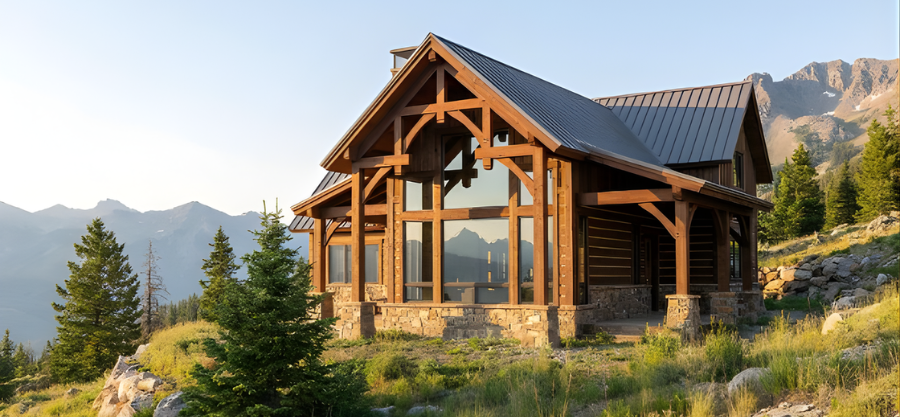
Timber framing adapts gracefully to these answers: posts and beams carry the load, freeing you to shift window walls, tuck in deep overhangs, or carve a porch into the lee side. Shape the structure around the site, and the site will repay you every morning.
Framing the views with structure
Because posts and beams carry the weight in a timber frame, your walls become canvases of glass. Keep the window-to-wall ratio on the main façade close to 30 percent—a balance that protects energy performance while showcasing the view, notes Green Building Advisor. From there, layer glazing the way a photographer composes a shot: a floor-to-ceiling window wall anchors the primary panorama; a clerestory band pulls sky light as far as 1.5 × the window-head height into the room, according to research from Lawrence Berkeley National Laboratory; and a covered timber porch softens the transition between interior and ridgeline. When these elements align with sunrise over the peaks or sunset down the valley, every glance feels intentional, not accidental.
Balancing openness and coziness
A soaring great room feels majestic until a winter storm rolls in and you crave a sheltered corner. Custom timber-frame builders such as Hamill Creek Timber Homes show how a single structure can swing from a light-filled, airy interior to a cozier nook simply by stepping ceiling heights and clustering beams, a real-world example of layering volumes the way you layer clothing.
Keep the main gathering zone generous, about 15 × 15 feet (roughly 4.6 × 4.6 m) with a peak ceiling around 18 feet (5.5 ma proportion that still lets furniture and lighting feel grounded, according to Timber Home Living. Step the ceiling down to 9 or 10 feet (2.7–3.0 m) in adjoining nooks or offices; a study published in the Journal of Consumer Research shows lower ceilings cue a sense of confinement that the brain links to intimacy and focus, while heights above 10 feet foster feelings of freedom.
Posts, beams, and even a single dropped timber truss can hint at room boundaries without raising walls, and a hearth-side bench at standard seat height—18 inches (46 cm)—anchors the coziest spot in the house. By modulating height, scale, and timber rhythm, you give the family a choice between wide-open celebration and tucked-in retreat, often within a few steps.

Managing light, heat, and comfort
Mountain sun can shift from gentle to punishing within a single season, so the shell of a timber frame must moderate those swings. Start with orientation: the U.S. Department of Energy recommends keeping most collecting glass within 30° of true south and shading it during summer’s high sun angle. A modest roof or pergola that projects about 18 inches (460 mm) over a 4-foot-tall (1.2 m) window blocks noon sun in July yet lets low January light pour in.
Behind that glass, a wall system built from 4- to 8-inch (100–200 mm) structural insulated panels (SIPs) can trim heating and cooling use by 12–14 percent compared with conventional framing, while delivering airtight R-values in the high 20s. Finally, place openable windows on opposite walls; cross-flow ventilation stays effective up to five times the ceiling height between inlets and outlets, giving you a free cooling strategy on mild evenings.
Working with a design team fluent in both timber engineering and local climate data turns these guidelines into detailed specifications and keeps the great room bright in February without turning it into an oven in July.
Material choices that support the setting
Let the site set the palette. In high-snow zones, builders often choose a 7-in-12 roof pitch or steeper because shallower slopes (6-in-12 and below) struggle to shed heavy drifts naturally, notes Fine Homebuilding. Pair that roof with local stone at the foundation; sourcing rock within a 500-mile (about 800-km) radius keeps embodied carbon within the Environmental Protection Agency’s top 20 percent low-carbon tier for concrete and masonry, according to the EPA. Choose stains that echo the dominant tree species: darkened fir feels warm, while a clear finish on spruce reads contemporary, helping the frame blend rather than compete. Indoors, wide plank flooring reclaimed from regional barns adds character and lowers the energy footprint of new lumber. When color, mass, and roof geometry mirror the mountain’s own language, the house looks settled on day one and performs season after season in snow, sun, and wind.

Planning for everyday life, not just the postcard
Those ridgeline windows may sell the dream, but daily comfort lives in the spaces behind the camera. Start at the back door: families in snow country typically allocate 60–130 square feet (about 5.6–12.1 m²) for a mudroom, enough for individual cubbies and a boot-drying bench, according to recent Houzz case studies.
Flow next to the kitchen. The National Kitchen & Bath Association defines a medium kitchen as 151–350 square feet (14–33 m²)—room for two cooks to move comfortably without stretching the work triangle beyond its recommended 26-foot (7.9-m) perimeter. Keep the laundry within one flight of the bedrooms to cut daily steps, and size a guest room at roughly 120 square feet (11 m²) so friends feel welcome without inflating heating loads.
When each behind-the-scenes zone works effortlessly, the view wall stays just as photogenic, only now it supports a household that runs smoothly all year.
Turning a vision into a buildable plan
Most custom timber homes move from first sketch to building permit in stages you can plan for. Expect six to seven months to refine drawings and another two months for the frame to be cut and delivered, according to Timber Home Living’s construction timeline. Design services typically cost eight to fifteen percent of the total construction budget, a range confirmed by the American Institute of Architects.
Here’s how to keep those months productive:
-
Start a digital or physical scrapbook of images that capture room sizes, exterior colors, and even trail signage you love: anything that conveys mood and material.
-
Separate must-haves (three bedrooms, attached garage, studio loft) from nice-to-haves, then share that hierarchy with your architect.
-
Meet early with a timber-frame design-build firm so they can test your wish list against site slope, snow load, and budget.
-
Review every iteration; many owners discover a better window wall or a leaner footprint once they see sun-path studies overlaid on the plan.
Conclusion
When the design phase has both clear priorities and realistic checkpoints, the finished timber frame feels inevitable, as if the house was waiting for its spot on the ridge all along.